

Turn clinical conversations into structured documentation with clinical document management system
MediNoteX AI helps healthcare professionals reduce the burden of manual documentation by transforming doctor-patient conversations into structured clinical records, prescriptions, and standardized SOAP notes.
Spend less time documenting and more time focusing on patient care.

Transform the Way Clinical Documentation Works
Clinical documentation is an essential part of every consultation, but manually capturing conversations, preparing notes, writing prescriptions, and maintaining structured records can consume valuable clinical time.
The software supports the documentation workflow by capturing relevant information from consultations and organizing it into structured clinical outputs.
From the initial conversation to the finalized clinical record, the solution helps create a more efficient and consistent documentation process.
- Capture consultation conversations
- Convert conversations into structured clinical notes
- Generate prescription drafts from consultation insights
- Create standardized SOAP notes
- Review and edit AI-generated documentation
- Maintain consistent clinical records
How Intelligent Clinical Documentation Works
Conduct the Consultation
The clinician focuses on the patient while the consultation takes place naturally.
Capture the Conversation
The system processes the clinical conversation and identifies relevant information.
Understand Clinical Context
The system organizes relevant patient information, symptoms, observations, assessments, and treatment-related information.
Generate Structured Documentation
The captured information is transformed into structured clinical documentation.
Generate Supporting Outputs
Depending on the workflow, this solution can generate structured notes, prescription drafts, and SOAP documentation.
Review & Finalize
The clinician reviews the generated content, makes any required corrections, and finalizes the clinical record.
Structured Clinical Note Generation
Convert Clinical Conversations Into Structured Notes
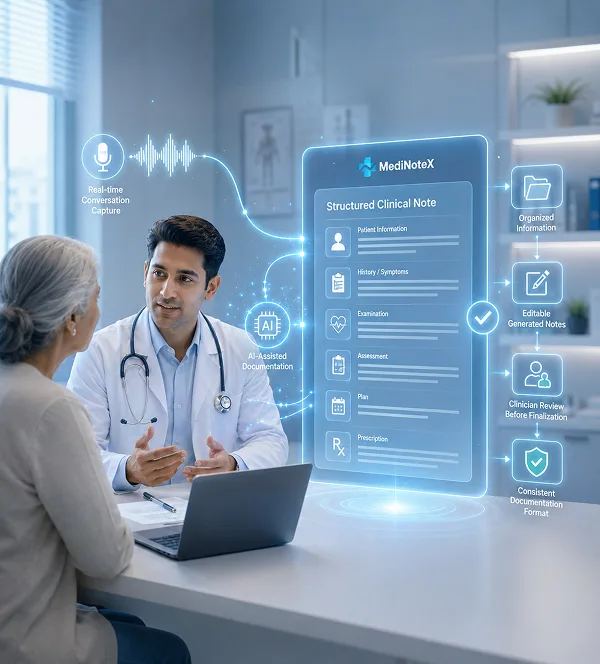
MediNoteX AI transforms doctor-patient conversations into organized clinical records in real time, helping clinicians capture important consultation information without relying entirely on manual note-taking.
Instead of documenting every detail manually during or after the consultation, clinicians can focus on the patient while the medical record management system helps structure the relevant information.
- Real-time clinical conversation capture
- Structured clinical note generation
- Organization of consultation information
- AI-assisted documentation
- Editable generated notes
- Clinician review before finalization
- Consistent documentation format
Streamlined Prescription Management
Turn Consultation Insights Into Prescription Drafts
Prescription documentation can add another layer of administrative work to every consultation.
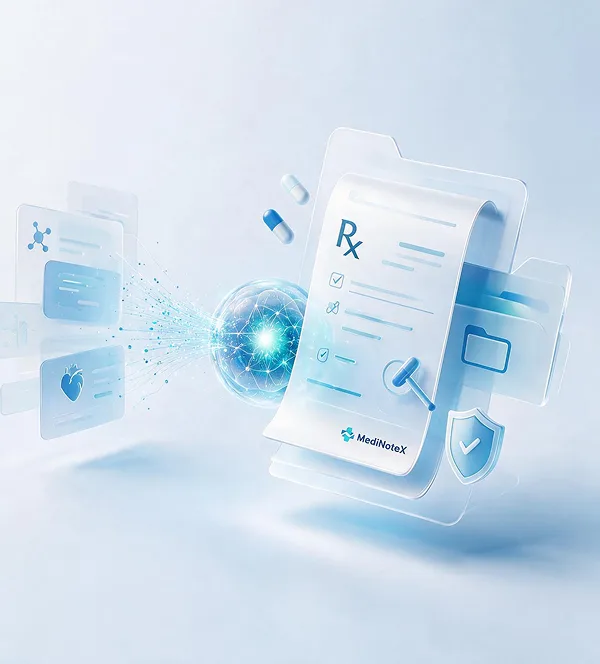
The system uses information captured during the consultation to assist in generating prescription documentation, reducing repetitive manual effort.
- Reduce repetitive prescription documentation
- Connect prescription creation with consultation information
- Minimize manual data entry
- Maintain prescription documentation alongside the clinical record
- Allow clinicians to review and modify generated information
Automated SOAP Notes
Standardize Clinical Documentation With AI-Powered SOAP Notes
SOAP documentation provides a structured approach to recording patient encounters.
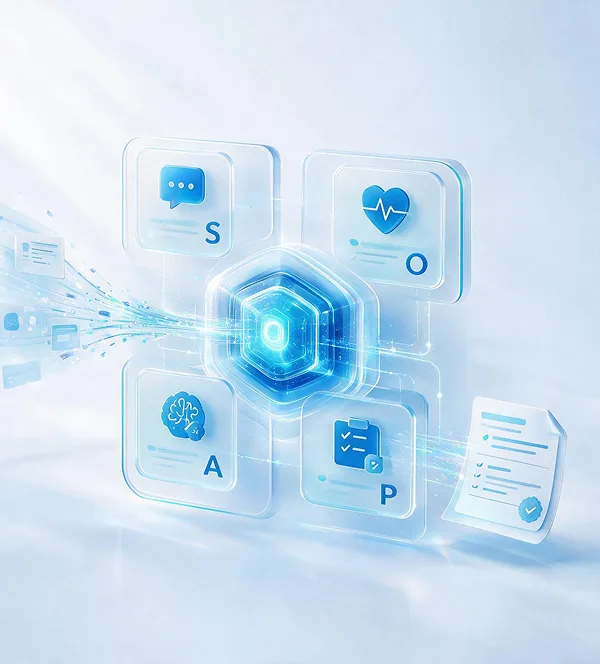
The solution helps organize relevant consultation information into the four core components of a SOAP note.
- Subjective – Capture information reported by the patient, including symptoms, concerns, and relevant history.
- Objective – Organize relevant clinical observations and information available from the consultation.
- Assessment – Structure the clinician’s assessment based on the documented consultation information.
- Plan – Document proposed treatment, follow-up, recommendations, and next steps.

Built Around the Clinician, Not the Documentation
Focus on the Patient. Let AI Assist with the Documentation.
The solution is designed to support clinicians rather than replace clinical judgment.
The clinician remains in control of the final documentation while AI assists with capturing, organizing, and structuring information.
- AI-Assisted – Helps capture and organize consultation information.
- Clinician-Controlled – Clinicians review and modify generated content.
- Structured – Information is organized into consistent documentation formats.
- Connected – Clinical notes and related documentation can be created as part of the same consultation workflow.
Key Benefits of Intelligent Clinical Documentation

Reduce Documentation Time
Minimize repetitive manual note-taking and documentation activities.
Reduce Documentation Time
Minimize repetitive manual note-taking and documentation activities.

Improve Documentation Consistency
Use structured formats such as SOAP notes to create more consistent clinical records.
Improve Documentation Consistency
Use structured formats such as SOAP notes to create more consistent clinical records.

Reduce Administrative Burden
Automate repetitive documentation tasks so clinicians can spend more time on patient care.
Reduce Administrative Burden
Automate repetitive documentation tasks so clinicians can spend more time on patient care.

Support Faster Consultation Workflows
Move efficiently from consultation to structured documentation and review.
Support Faster Consultation Workflows
Move efficiently from consultation to structured documentation and review.

Improve Clinical Record Organization
Keep consultation information organized in structured clinical documentation.
Improve Clinical Record Organization
Keep consultation information organized in structured clinical documentation.
Maintain Clinician Oversight
AI assists with documentation while clinicians retain control over reviewing and finalizing records.
Maintain Clinician Oversight
AI assists with documentation while clinicians retain control over reviewing and finalizing records.
Scale Across Clinical Teams
Support standardized documentation workflows across doctors, departments, and healthcare organizations.
Scale Across Clinical Teams
Support standardized documentation workflows across doctors, departments, and healthcare organizations.
Designed for Different Healthcare Workflows

Primary Care
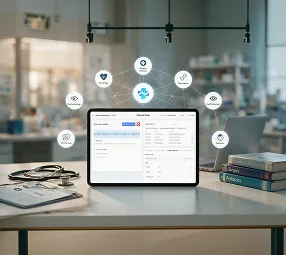
Support high-volume consultations with faster clinical documentation and structured notes.
Specialty Clinics
Use structured documentation workflows that can be adapted to different clinical specialties.

Hospitals
Support documentation across doctors, departments, and operational workflows.
Multi-Disciplinary Care
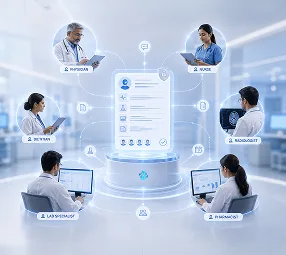
Create structured records that can support collaboration between different healthcare professionals.
Why Intelligent Clinical Documentation Matters
Every consultation creates documentation. When multiplied across dozens or hundreds of consultations, manual documentation can become a significant operational burden. The system helps move documentation from a manual, fragmented activity to a more structured, AI-assisted workflow.
The objective is simple: reduce documentation effort without removing clinical oversight.
Frequently Asked Questions
Intelligent clinical documentation uses AI to assist healthcare professionals in capturing, organizing, and structuring information from patient consultations into clinical documentation.
This clinical records management system processes information from doctor-patient conversations and organizes relevant clinical information into structured documentation that can be reviewed and edited by the clinician.
Yes. This clinical document management system supports AI-assisted SOAP note generation, helping organize consultation information into Subjective, Objective, Assessment, and Plan sections.
Yes. It can assist with prescription documentation based on consultation insights. Generated prescription content should be reviewed and approved by the authorized clinician before being finalized.
Yes. AI-generated documentation should be reviewed by the clinician, who can make corrections or modifications before finalizing the clinical record.
No. This is designed as an AI-assisted documentation solution. Clinical decisions and final approval of documentation remain with the appropriate healthcare professional.
The documentation workflow can be configured around the organization’s clinical documentation requirements, including the use of structured formats and templates.
Yes. It is designed to support healthcare documentation workflows across different clinical environments. Documentation requirements can vary by specialty and organization.
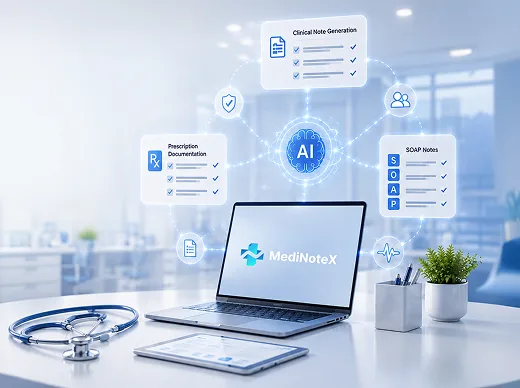
Bring intelligent clinical documentation into your healthcare workflow with MediNoteX AI.