


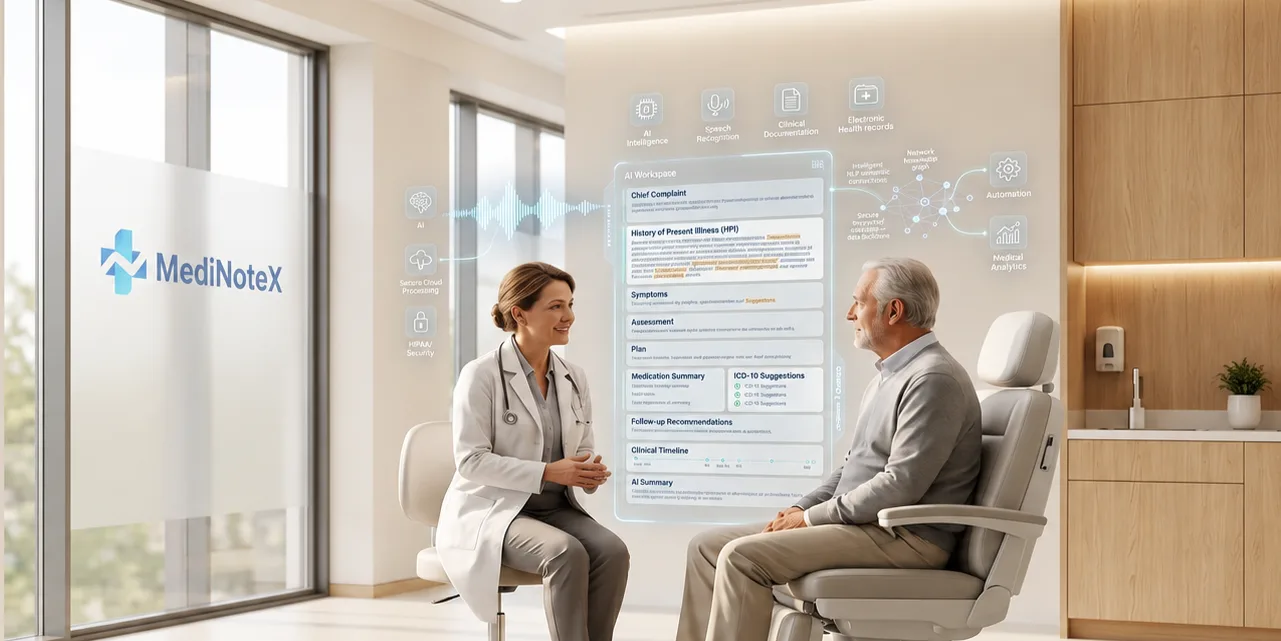
Artificial intelligence is fundamentally reshaping how healthcare documentation works, giving clinicians a way to finally step away from the keyboard and focus entirely on the patient in front of them. However, building an effective AI medical scribe software involves far more than simply converting spoken words into text. A truly successful solution must listen contextually, adapt naturally to complex clinic workflows, safeguard sensitive patient information, and deliver notes that providers can trust implicitly.
For healthcare technology providers, product teams, and developers, launching a great AI medical scribe solution requires a careful balance between cutting-edge AI innovation and practical, real-world clinical demands. Let’s dive into the core challenges of building a modern scribing platform and explore how comprehensive systems like MediNoteX AI by PIT Solutions are addressing them.
How Does AI Medical Scribe Software Work?
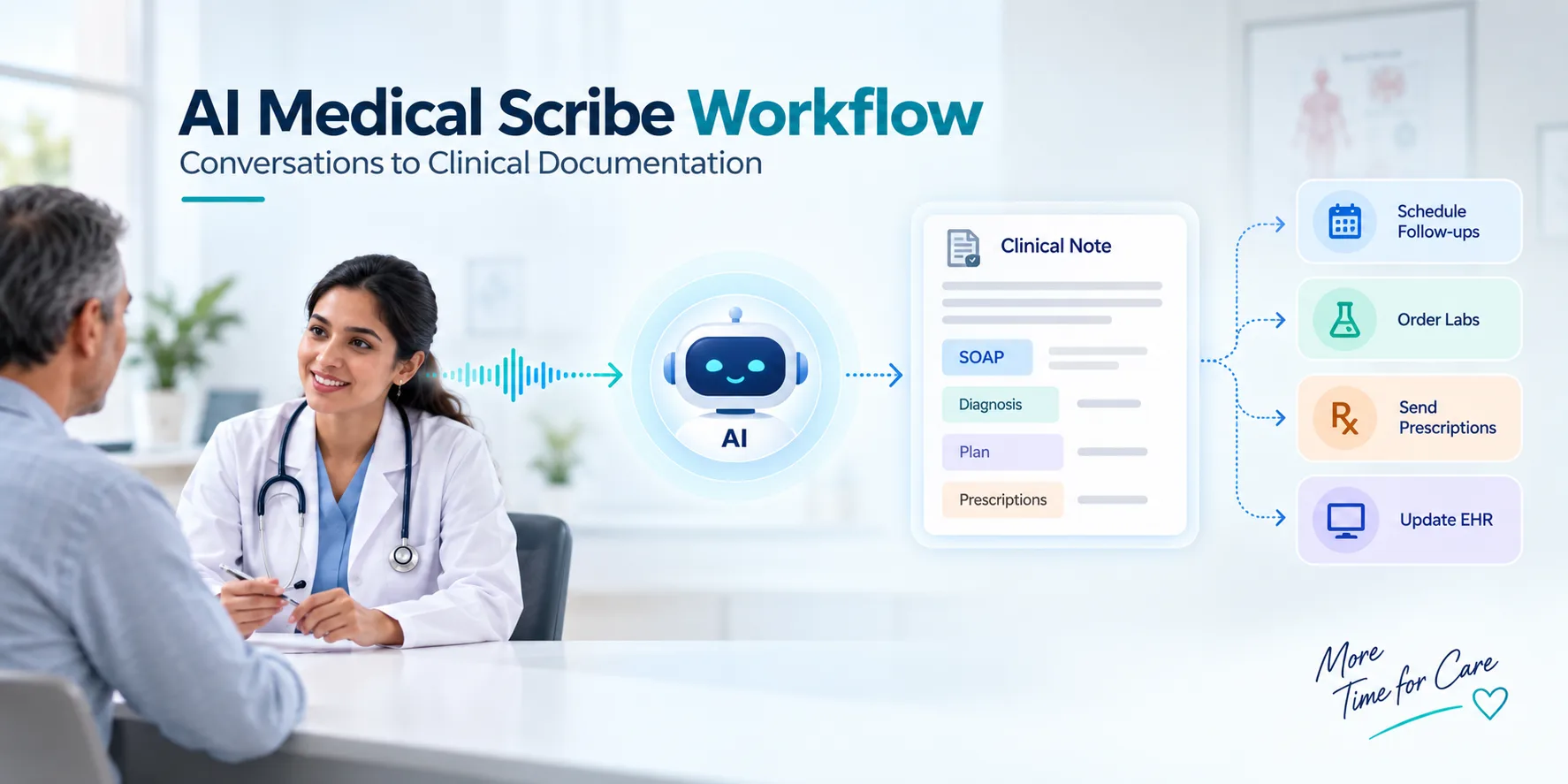
At its simplest, AI medical scribing uses artificial intelligence to securely listen to ambient doctor-patient conversations and translate them into structured, formatted clinical documentation. A modern platform can draft everything from raw consultation notes and diagnoses to prescriptions and highly organized SOAP notes in real-time.
However, generating a note is only half the battle. The true value of a medical scribe platform isn’t just its ability to transcribe-it’s how seamlessly it slips into the existing clinical workflow to support a medical team throughout the entire patient journey.
8 Key Considerations for Building an AI Medical Scribe
1. Master the Clinical Workflow Before Writing Code
One of the most common missteps in development is treating an AI scribe as a standalone voice-to-text app. A real healthcare journey begins long before the patient sits in the exam room and continues long after they leave. It involves scheduling, diagnostics, invoicing, and follow-up care.
If an AI tool merely generates a static note without connecting to these downstream steps, clinicians are still stuck manually copying and pasting data between multiple fragmented systems. Developers need to deeply analyze how modern clinics actually operate before locking in their software architecture.
2. Clinical Accuracy Goes Far Beyond Basic Dictation
Standard speech recognition isn’t enough for a medical environment. Real clinical conversations are messy-they are packed with complex terminology, shorthand, overlapping dialogue, and sudden shifts in topic. A doctor might interrupt a patient, switch languages mid-sentence, or address three unrelated symptoms in a single visit.
Because of this, an effective ambient AI must accurately parse evolving medical terminology, adapt to diverse accents, and actively learn from live verbal corrections. The ultimate goal is to produce a structured, actionable medical record rather than a chaotic raw transcript.
3. Design Around Connected Care Steps
The text generated by an AI medical scribe solution should serve as the natural launchpad for the next phase of patient care. Immediately following a visit, a clinician typically needs to order labs, write prescriptions, book a procedure, or schedule a follow-up appointment. By weaving these steps together using smart healthcare workflow automation, you eliminate tedious system navigation and give providers their time back.
4. Put Patient Data Management at the Center
Healthcare organizations rely heavily on accessible, cohesive records. When designing the backend architecture, developers should look past the individual consultation note and prioritize a unified patient record. Authorized staff should be able to instantly pull up a patient’s entire history-including past vitals, lab reports, imaging, and demographic details-from a single dashboard, drastically cutting down on duplicate paperwork and admin lag.
5. Treat Security and Compliance as a Foundation, Not a Checklist
Because these systems handle incredibly sensitive health information, security can never be an afterthought. Tight data security must be baked into the system’s DNA from day one. This means ensuring full HIPAA compliance, establishing rigid role-based access controls, creating unalterable audit trails, and enforcing strong encryption both at rest and in transit across all clinic departments.
6. Build for Every Role in the Building
Doctors aren’t the only ones interacting with your AI medical scribe for hospitals. Front office staff, clinic administrators, and lab technicians all touch the same patient timeline at various points. Designing custom interfaces and distinct permission tiers for each specific role ensures the software is easy to use for everyone while strictly protecting data privacy.
7. Code for Future Extensibility
While most clinics initially adopt AI just to survive their daily charting burden, their technical needs rapidly expand. As operations go fully digital, practices expect their AI platforms to grow with them-expanding into scheduling, billing, and advanced reporting. Building the core architecture with a modular mindset allows you to deploy new features down the road without triggering a full system redesign.
8. Keep Humans Firmly in the Loop
AI is meant to assist, not replace. Clinicians must always retain final editorial control over the medical record. Every single note generated by an AI clinical documentation needs to be easily reviewable and editable before it is officially locked into a patient’s permanent chart. This open oversight builds deep professional trust and ensures absolute clinical accuracy.
What Are the Benefits of AI Medical Scribing?
MediNoteX AI by PIT Solutions was built from the ground up around these exact operational realities. Rather than functioning as a standalone dictation app, it functions as a comprehensive ecosystem that merges ambient AI medical scribe features with deep healthcare workflow automation.
The platform effortlessly links real-time clinical documentation with the broader operational needs of a busy practice-handling online and offline scheduling, automated lab routing, integrated billing modules, and centralized patient directories under one roof. Backed by adaptive AI that continuously sharpens its accuracy based on user feedback, it brings secure, role-based, and HIPAA-compliant automation directly into existing EHR and HIS environments.
The Future of AI Medical Scribing in Healthcare
At the end of the day, building a great clinical management software isn’t just an AI challenge-it’s a healthcare challenge. Success depends on how well the software understands the unique rhythms of clinical life, protects patient privacy, and connects with the broader medical ecosystem. The future belongs to smart, unified platforms that quietly lift the operational burden off the entire clinic.
Ready to explore the future of clinical documentation? Book a Demo today to see how MediNoteX AI combines intelligent scribing with connected operations to power smarter, happier clinics.