

In today’s healthcare environment, managing patient information efficiently is essential for delivering quality care. Clinics and hospitals handle a significant amount of information every day, including patient details, consultation notes, medical histories, and treatment records. Managing this information manually can be time-consuming and prone to human error, making it difficult for healthcare professionals to maintain accurate, consistent, and organized records.
An Electronic Medical Record Management System (EMR) is a digital solution that replaces traditional patient charts with electronic records.It holds diagnoses, treatment notes, medications, test results and visit history in a single searchable system that clinicians can update at every visit. It allows healthcare professionals to maintain diagnoses, treatment notes, medications, test results, and consultation histories in an organized and searchable format.
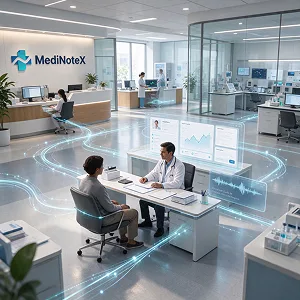
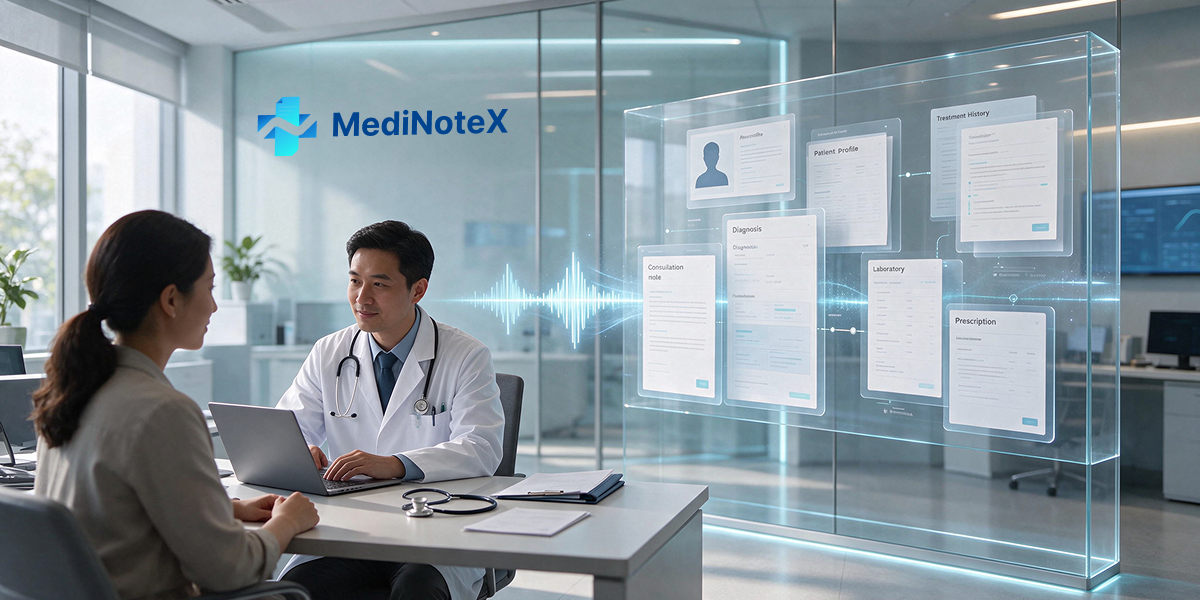
MediNoteX brings clinic and hospital management capabilities together with an additional feature that captures consultation conversations in real time and converts them into structured clinical notes, helping healthcare professionals simplify their documentation workflow.
What Is an Electronic Medical Record Management System?
An Electronic Medical Record Management System is a digital solution that helps healthcare providers create, organize, access, and manage patient medical records. It replaces or reduces dependence on traditional documentation and provides a more structured and quick approach to maintaining clinical information.
Depending on the system’s capabilities, Electronic Medical Record Management System supports different aspects of clinical documentation and patient management, such as:
- Maintaining digital patient information and records.
- Recording consultation details and clinical observations.
- Organizing treatment notes and medical documentation.
- Supporting day-to-day operations.
- Making patient information easier to access when required.
By bringing important information into a digital environment, an Electronic Medical Record Management System can help healthcare teams reduce manual administrative work and maintain more organized patient records.
Why Clinics and Hospitals Need an Electronic Medical Record Management System
Clinics or hospitals need to balance patient care with several administrative responsibilities. One of the most time-consuming tasks is documenting consultations and maintaining patient records.
Traditional documentation methods can create challenges, including:
1.Time-Consuming Documentation
Doctors often need to document consultation details while managing patient interactions. Preparing notes manually after every consultation can add to their workload and extend administrative tasks.
2. Faster access to patient information.
Clinicians can pull up a full history in seconds instead of searching multiple documents or systems, which shortens waiting times
3. Repetitive Administrative Work
Updating consultation records, and preparing clinical notes can involve repetitive tasks. These activities may reduce the time available for direct patient care.
4. Maintaining Consistent Clinical Notes
Incomplete or inconsistently structured documentation can make it harder for clinicians to review consultation information. Having a more organized documentation process can help improve consistency.
An effective Electronic Medical Record Management System will help in addressing these challenges by supporting digital record management and simplifying documentation workflows.
How MediNoteX Supports Electronic Medical Record Management
MediNoteX is a clinic or hospital management system designed to support daily operations and simplify clinical documentation. Along with its management capabilities, MediNoteX includes an AI-powered medical documentation feature that transforms doctor-patient conversations into structured clinical records, prescriptions, and standardized SOAP notes.
Here is how MediNoteX can support healthcare professionals in their daily documentation activities.
1.Capture Consultation Conversations
In the traditional method during a patient consultation, doctors need to listen carefully, understand symptoms, discuss medical history, and recommend appropriate treatment. Taking detailed notes while maintaining a natural conversation can be challenging.
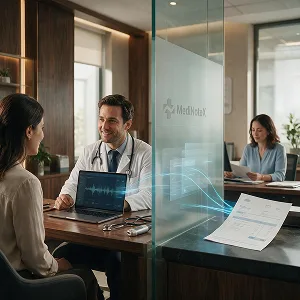
MediNoteX helps simplify this process by AI-powered transcription and note generation to transcribe consultation conversations and convert them into structured clinical notes, generate prescription drafts from consultation insights, creating standardized SOAP notes, review and edit AI-generated documentation, and maintain consistent clinical records.
2. Generate Structured SOAP Notes
Clinical notes need to have relevant consultation information in an organized format. MediNoteX supports the generation of structured SOAP notes, helping organize consultation details.
Doctors can review and edit the generated notes before finalizing or exporting, ensuring that the documentation reflects the consultation accurately.
3. Reduce Manual Documentation Effort
Preparing consultation notes manually can take up time, particularly in busy clinics and hospitals where doctors handle multiple appointments throughout the day.
MediNoteX helps reduce repetitive note-taking activities and allows healthcare professionals to focus more on patient interactions by automating documentation parts.
4. Support a More Connected Clinical Workflow
An effective Electronic Medical Record Management System should support more than just digital documentation, it should fit into the broader workflow of a healthcare facility.
More than a notetaker, MediNoteX is a full management system, the notes sit inside the same platform that handles hospital workflow and operations, multi-user and multi-device access, and reporting. One system, one record, no copying between tools.
Choosing the Right Electronic Medical Record Management System
Selecting an Electronic Medical Record Management System requires considering the needs and workflows of the healthcare facility. Beyond basic digital record management, healthcare providers should evaluate whether a system can support their documentation and operational requirements.
Some important factors to consider include:
- Ease of use: The system should be straightforward for doctors and administrative teams to use.
- Documentation capabilities: Look for features that simplify consultation notes and clinical documentation.
- AI-powered assistance: Automated transcription and note generation can help reduce manual documentation efforts.
- Workflow suitability: The solution should align with the facility’s existing clinical and administrative processes.
- Data security: Patient information should be handled in accordance with applicable privacy and security requirements.
- Scalability: The system should be suitable for the facility’s current needs and future growth.
Choosing a solution that brings management and documentation capabilities together can help healthcare providers build a more efficient digital workflow.
End of Day: No More After-Hours Documentation
MediNoteX combines clinic and hospital management capabilities with AI-powered consultation documentation, helping healthcare professionals capture consultation conversations, generate structured notes, and reduce manual documentation efforts.
If you are looking to simplify your clinical documentation workflow, explore how MediNoteX can support your healthcare facility.
Book a demo with MediNoteX today and discover a smarter approach to clinical documentation and healthcare management.