

Artificial intelligence has already transformed clinical documentation, but documentation alone isn’t enough to solve today’s healthcare challenges. Hospitals and clinics continue to face fragmented workflows, where consultations, diagnostics, billing, reporting, and follow-up care are often managed across multiple systems and teams.
The next frontier in medicine isn’t about creating better standalone tools-it is about tying these isolated tasks into a single, fluid experience.
This is exactly where MediNoteX AI by PIT Solutions changes the game. While it functions as a highly intuitive AI medical scribe software, it is far more than a transcription tool. The platform acts as a digital nervous system for clinics, bridging the gap between real-time clinical documentation, deep healthcare workflow automation, laboratory logistics, and cross-department collaboration.
What Is an AI Medical Scribe?
An AI medical scribe software is an intelligent software system that listens to doctor-patient conversations and turns relevant information from the encounter into structured clinical documentation.
Medical scribe softwares of the present day can not only transcribe conversations as they happen, but understand the clinical context and organize the information into usable medical records, not just relying on manual note-taking or dictation after the consultation.
Depending on the platform, this may include consultation notes, SOAP notes, diagnoses, prescriptions and other clinical documentation. But the important evolution is that the documentation generated does not have to be a static record. When integrated with other healthcare workflows it can be the launch pad for follow-up clinical and administrative actions.
Why Healthcare Needs More Than AI Medical Documentation
The earliest versions of AI in medicine focused on one massive pain point: the administrative burden on doctors. By turning conversational dialogue into structured summaries, a clinic management software could successfully rescue physicians from their keyboards, letting them look at their patients instead of a screen.
But modern clinics have outgrown simple dictation. A single patient visit sets off a complex chain reaction: prescriptions are written, labs are ordered, bills are generated, and follow-ups are scheduled. When these tasks rely on legacy software or manual messaging, the entire system slows to a crawl.
True efficiency means using AI that doesn’t just stop when the note is finished, but actually pushes the entire care cycle forward.
How AI Medical Scribe Software Connects the Patient Journey
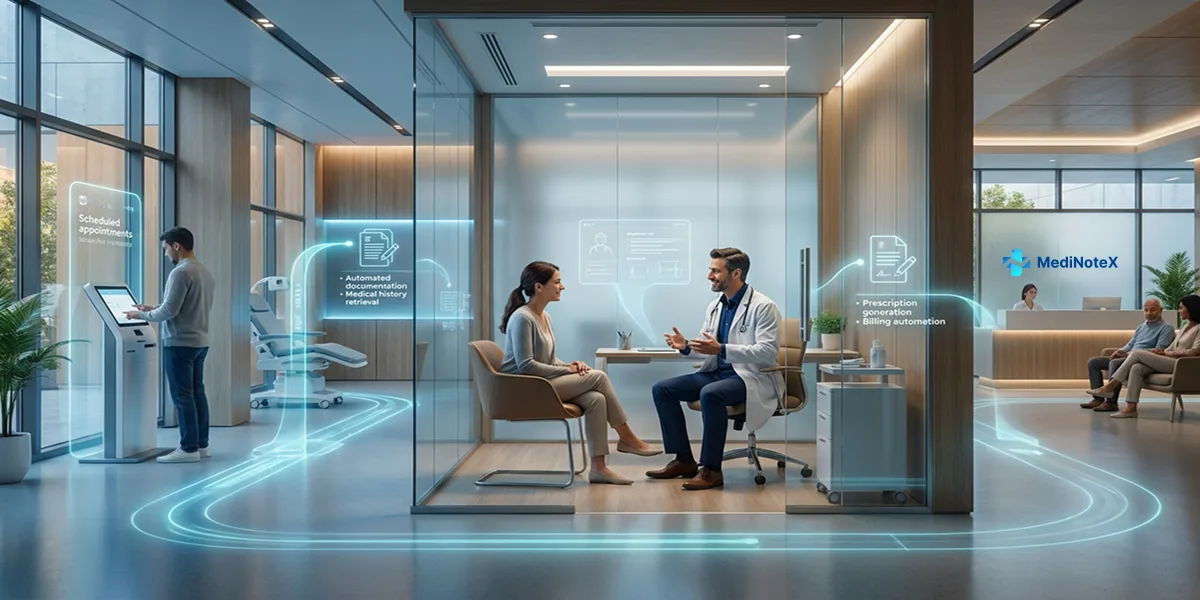
The consultation can go from a solo documentation event to the start of a larger patient workflow with a connected all-in-one clinic management software.
Appointment Scheduling
The first step of the patient journey is appointment scheduling. Front Office teams can schedule appointments for patients when needed. This provides a structured foundation for the patient journey and ensures that the teams involved already have the consultation information before the visit begins.
Real-Time Clinical Documentation
The AI listens to the conversation and then creates structured clinical documentation in real time during the consultation. The doctor can review the generated material, edit as needed and complete the documentation, without having to manually re-create the entire encounter later. Consultation notes, diagnoses, prescriptions, and standardized SOAP documentation may be included in the end record.
Procedure Management
Not every patient visit is a classic consultation. Consultations and Procedures are two different types of clinical encounters and the workflow can accommodate both. Procedures can be scheduled as part of the patient’s care journey, so that the associated appointment and service details are tied to the patient’s records and follow-on clinical and billing workflows.
Automated Prescriptions and Reports
Clinical documentation can also be used to produce other outputs required during patient care. Rather than consider the consultation note as the end of the process, an integrated platform can connect the information collected during the encounter to prescription management and reporting. This allows for a more continuous flow of documentation while giving the clinician the ability to control the review and approval of the generated information.
Integrated Lab Orders and Results
Laboratory investigations follow naturally from many consultations. If the doctor decides that laboratory testing is indicated, appropriate tests can be included in the workflow for the consultation. This allows the resulting laboratory orders to flow through the appropriate Front Office and Lab workflows without the need for separate paper-based communication. Lab Technicians are able to view orders, enter results, mark reports as complete, and generate laboratory reports. Completed reports are placed in the patient’s chart and can be retrieved when needed later.
Connected Front-Office and Billing Workflows
Clinical decisions have common operational consequences. When lab tests or other billable services are added at the time of a patient encounter, the information flows into the appropriate administrative workflow. Laboratory orders can be seen by Front Office teams and the billing process taken care of so that doctors don’t have to communicate the same information separately to administrative teams. For clinics, this means a more connected workflow between clinical documentation, services, and billing.
Centralized Patient Records and Follow-Up
Medical notes are only as good as how easy they are to find later on. Instead of old details getting buried under a mountain of disconnected charts, doctors can pull up prior visits, lab work, and past notes right when they need them.
Features like the Report Module make tracking down generated patient files straightforward, and jumping into the View History tab means you actually have the full story in front of you for a follow-up. It keeps what happened in a visit three months ago just as useful today, without anyone having to dig through separate systems to piece it all together.
From AI Medical Scribe to Clinic Management Software
Whatever happens after the clinical documentation phase, that defines the transfomation of a normal AI medical scribe for doctors into a full fledged clinic management system. Simply developing a clinical note for the physician does not overcome the operational bottleneck happening in a healthcare setup.
A proper healthcare workflow automation happens when the clinical documentation is synced with the rest of the clinic’s activities like appointment scheduling, prescription management, lab management, medical billing, updating charts and queueing follow-ups without the need to re-enter information by anyone.
It’s about letting the scribe serve as the front door to the entire workflow, turning a simple conversation into actual clinic operations.
How AI Medical Scribe Software Supports Clinic Management
When AI medical scribing and clinical workflow automation exists in a single ecosystem, that creates a perfect healthcare management software.
The documentation is generated during the doctor-patient consultation session, which can be modified and added with lab orders and any extra prescription or procedure, by the doctor. Once proceeded, the lab orders go to the lab, prescription to the pharmacy and the billing will be handled simultaneously for these. Eventually lab can process the order, generate results and saved into the patient record for future references.
How MediNoteX AI Supports Every Role in a Clinic
A well-connected AI medical scribe software for hospitals becomes highly valuable when each role in the system can work with the same patient data just by relying on the functions they are supposed to perform.
Clinic Admin
They oversee the overall workflow of the clinical operations, verifying that the clinical, laboratory and administrative processes are working smoothly. They are also responsible for configuring and managing the pricing process.
Physicians
Physicians use the platform for generating AI powered structured documentation from the consultations, creating the reports on diagnosis, prescriptions and lab orders.
Front Office Teams
Front office team manages the appointment scheduling, laboratory orders and billing. They acquire the order once doctor pushes the generated report into the system.
Lab Technicians
Lab technicians create lab orders as well as process the received lab order from doctor’s documentation, complete the tests and add the reports into the patient data. This report is send to the patient to download through email or SMS, as well as saved in patient records for future follow-ups.
Nurse
Nurses can upload the patient’s vitals directly into the patient’s medical records, which can then be made available to the doctor and other authorized healthcare staff for reference.
AI Medical Scribe vs. Traditional Medical Scribe
Traditional medical scribing was focused simply on converting consultations into written documentations. This would consume a lot of time for the doctors.
AI medical scribe software listens to the consultation, understands clinical context and create structured reports, thus reducing the manual effort of doctors in documentation process and enhancing their efficiency.
The greater potential of AI healthcare solutions emerges when this intelligent clinical documentation syncs up with the workflow of the clinic, automating the processes across every section of the system.
Security, HIPAA Compliance and EHR/HIS Integration
Connecting the documentation with the clinical workflows is really important for the security and interoperability of the healthcare system. When we talk about a healthcare platform it is very important that it keeps the patient information safe and secure. At the time it should allow the teams that are authorized to access the information they need to do their jobs.
MediNoteX AI does a lot of things to help with this including:
- HIPAA-compliant security standards.
- Encryption of Protected Health Information (PHI).
- Role-based access controls.
- Secure information sharing across departments.
- Multi-device accessibility.
- EHR and HIS integration.
All these things that MediNoteX AI does make it possible for organizations to use intelligence to improve their workflows and they can do this without having to change their existing healthcare technology systems.
Ready to Build a Smarter, More Connected Clinic?
Clinics are tired of buying piecemeal software that solves only one problem at a time. Today’s healthcare leaders are investing in comprehensive platforms that optimize the entire business while elevating patient care.
By combining advanced AI medical scribe software with real-time clinical documentation, embedded lab modules, and intelligent healthcare workflow automation, MediNoteX AI removes the friction from modern medicine. It creates an ecosystem where technology supports every single step of the care journey.
Ready to see a smarter clinic in action? Book a Demo today to discover how MediNoteX AI can automate your clinical documentation, optimize your daily workflows, and elevate the patient experience from check-in to follow-up.