


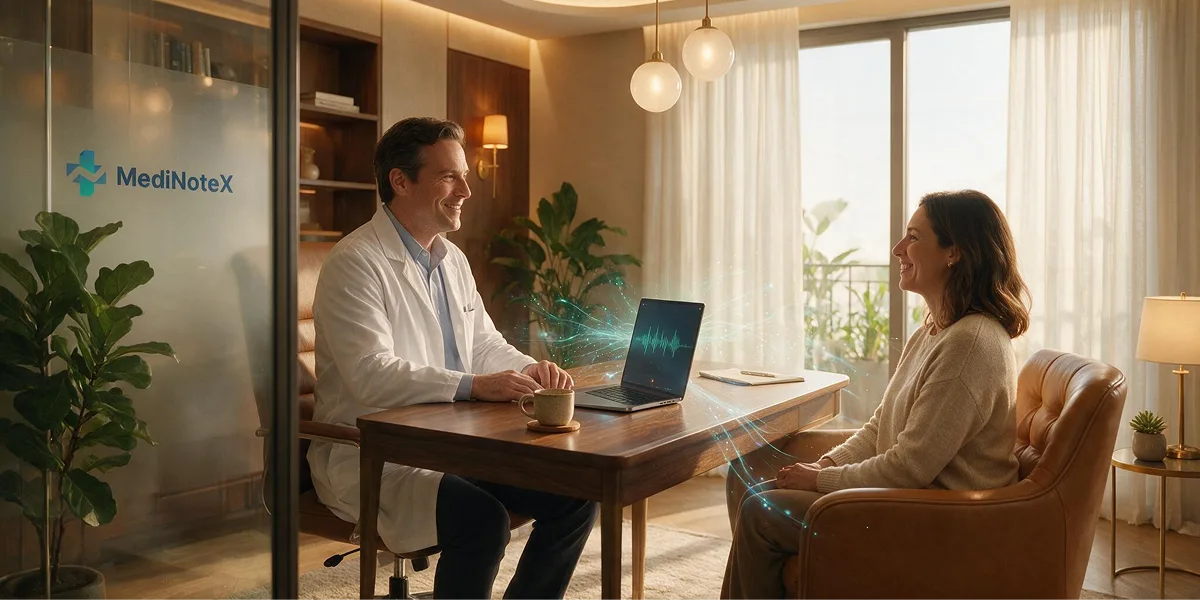
Clinical documentation has always been a paradox in modern healthcare. On one hand, it’s vital, a foundational part of delivering safe, accountable care. On the other, it’s a massive drain on physicians’ time and attention. For years, doctors have found themselves spending more hours typing up notes than talking to patients. And for many, the paperwork doesn’t stop when they leave the clinic.
In an age where every sector is looking to AI to ease its heaviest burdens, medical documentation is no exception. But while AI chatbots and diagnostics grab the headlines, a quieter, more grounded application is already making a difference: AI medical scribe software. Solutions like MediNoteX AI by PIT Solutions are completely rewriting the playbook on clinical documentation-turning a tedious chore into a fast, highly accurate, and connected experience.
These tools aren’t trying to replace doctors or diagnose conditions. They’re here for something far more practical, reducing the administrative overload that gets in the way of care, and implement clinical workflow automation.
Why Clinical Documentation Slows Healthcare Providers
Consider the average day in a busy clinic. A physician might see upwards of 20 patients. For each consultation, they need to capture SOAP notes (Subjective, Objective, Assessment, Plan), update patient records, potentially issue prescriptions, and ensure compliance with institutional documentation policies.
This isn’t just time-consuming, it’s exhausting. Burnout among healthcare professionals is often linked to the sheer volume of clerical work required. In fact, multiple studies show that doctors spend nearly twice as much time on paperwork as they do with patients.
This imbalance doesn’t just hurt clinicians. It affects patients too, leading to rushed appointments, decreased face time, and slower follow-ups. It’s a cycle that traditional transcription tools, which still require human cleanup and editing, haven’t managed to fix.
How AI Medical Scribes Improve Clinical Workflows
AI scribes represent a new category of assistive technology. Rather than functioning like a passive dictation tool, they actively listen to clinical conversations and extract structured medical notes in real time. Think of them as digital assistants trained specifically to understand medical terminology, patient dialogue, and documentation standards.
Here’s where they stand out:
- Real-time voice-to-text transcription: Unlike older systems that relied on post-consultation dictation, AI scribes can capture information as it’s spoken, with impressive accuracy.
- Contextual understanding: Modern AI drives SOAP notes automation by listening to a visit and instantly sorting the conversation into patient complaints, clinical assessments, and treatment plans.
- Customisation and control: Physicians can toggle features like diagnosis suggestions or automated prescription drafts, depending on their preferences.
- Integrated clinical workflows: Beyond basic charting, modern platforms use healthcare workflow automation to link consultation notes directly with appointments, prescriptions, lab orders, billing, and patient records, completely cutting out the usual phone tag between medical teams.
- End-to-end integration: The best systems go far beyond basic transcription-they automatically generate comprehensive clinical reports, sync seamlessly with your EHR and HIS platforms, and securely share critical care updates across departments while strictly enforcing role-based access controls.
This is exactly where platforms like MediNoteX AI push past the limits of a traditional scribe. Instead of just handing you flat clinical text, it ties your consultation records directly into your appointments, lab workflows, billing, reports, and overall patient management-streamlining your entire practice’s daily operations without ever forcing clinicians to change the way they care for patients.
Benefits of AI Medical Scribe Software
Despite the hype around AI in healthcare, many hospitals and private practices are still cautious about new technologies. But AI medical scribe softwares are gaining ground, not because they’re flashy, but because they solve a real problem with minimal disruption.
Clinicians don’t need to learn a new interface or change how they consult. The AI sits in the background, doing its job, and freeing up cognitive space. It’s a rare case where the technology truly “gets out of the way.”
In outpatient settings, especially, this can be transformative. Doctors reclaim hours per week. Patient interactions feel more human. Documentation errors drop. And support staff aren’t stuck cleaning up partial records. Together, all of these culminate in a clinical workflow automation.
Security, HIPAA Compliance, and Data Privacy
As with any technology handling patient data, trust and compliance are paramount. High-quality AI scribe platforms are built with HIPAA and GDPR in mind. Encryption, access control, audit trails, all must be in place from day one.
Physicians also expect transparency in how data is processed. They need the ability to review and edit notes before they are finalized, along with assurance that the system can adapt to their individual speaking styles and accommodate regional medical terminology.
The best solutions are built around these expectations. They give doctors control, not just automation. And they prove their value not through dashboards or demos, but through quieter evenings and reduced burnout.
Why Healthcare Providers Are Adopting AI Medical Scribes
Sure, AI scribes save time. But the deeper value lies in what that time makes possible:
- More meaningful patient interactions: When doctors don’t have to multi-task during consultations, they listen better. Patients feel heard. Trust improves.
- Better continuity of care: Complete, accurate notes lead to fewer errors and improved care coordination.
- Scalability: As patient volumes grow, AI clinical documentation help organisations maintain care quality without burning out staff.
And let’s not forget training and mentoring. When residents and junior doctors aren’t buried in paperwork, they can focus on learning medicine, not memorising template shortcuts.
Conclusion
AI medical scribes are still evolving. Expect to see tighter integrations with EHR platforms, smarter voice assistants, multilingual capabilities, and even predictive note suggestions. But the core idea will remain the same: empower physicians to do what they trained for, care for people.
The future of medical documentation may not be paperless just yet. But with AI medical scribes, it can certainly be less painful. And that, in healthcare, is no small victory. Discover how AI clinical documentation can quietly transform your clinical practice, without disrupting your workflow.
Book a demo with MediNoteX to see it in action.